
Following a consistent garage door maintenance checklist is the single best thing a homeowner can do to avoid unexpected breakdowns — and most people don't do it at all. Your garage door is the largest moving part of your home. It opens and closes somewhere between 1,500 and 2,000 times a year. The hardware is under constant tension, the panels take weather and UV exposure daily, and the opener motor runs through thousands of cycles over its lifespan. Most homeowners don't think about any of that until something breaks.
That's backwards. A little routine maintenance goes a long way toward preventing the kind of failures that leave you stranded in your driveway on a weekday morning.
Here's what you should be doing — and when.
Know Your Usage Level First
Before I give you a maintenance schedule, you need to know where you fall:
Daily use — Your door opens and closes multiple times every day. This is most households where the garage is the primary entry point.
Weekly use — You go in and out of your garage occasionally. Maybe it's storage, maybe you park one car there on weekends.
Your usage level determines your lubrication frequency. Everything else on this checklist is annual.
Every 6 Months (Daily Use) or Every Year (Weekly Use): Lubricate Moving Metal Parts
This is the single most impactful thing you can do yourself, and most homeowners either skip it or do it wrong.
What to lubricate: hinges, rollers, and springs.
What to use: a garage door-specific lubricant. White lithium grease spray or a product like WD-40 Specialist Garage Door Lubricant both work well.
What NOT to use: standard WD-40. It's a solvent and degreaser, not a lubricant. It'll clean your parts, but it won't protect them — and on springs especially, that's a problem. I see dried-out, corroded springs on doors that homeowners swear they "keep lubricated." Nine times out of ten, they used WD-40. Even LiftMaster's own maintenance guidance lists lubrication as one of the most common reasons a door stops working correctly.
Here in Contra Costa and the surrounding Bay Area, our coastal air accelerates corrosion on metal components faster than most of the country. Homeowners in Benicia, Vallejo, and Martinez deal with salt-laden air that's hard on springs and hinges year-round. Regular lubrication is even more important here than it would be in an inland, dry climate.
How to do it: Wipe down the hinges and roller stems with a rag first to remove old grease and debris. Apply lubricant to each hinge pivot point, roller stem (not the nylon wheel itself if you have nylon rollers), and along the length of each torsion spring. Work the door up and down a few times manually to work the lubricant in. Wipe off any excess.
This takes about 15 minutes and costs next to nothing. Do it on a schedule.
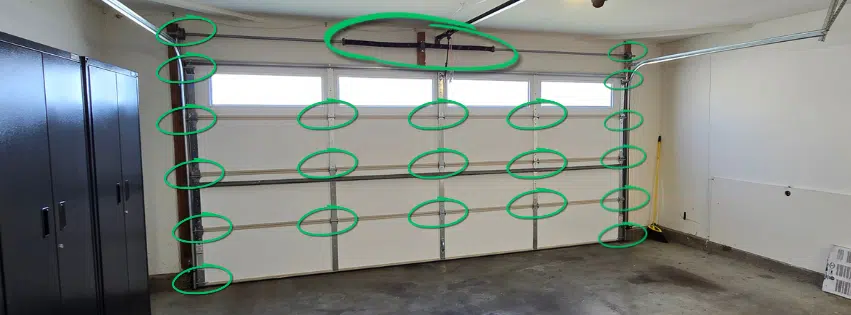
Every Year: Visual Inspection
Walk the door and look at everything. You're looking for:
- Panels — dents, cracks, warping, rust spots. Surface damage isn't just cosmetic; warped or cracked panels affect the door's seal and structural integrity.
- Tracks — debris, dents, or sections that look bent or out of alignment. The door should ride smoothly with no grinding or scraping.
- Rollers — nylon rollers should spin freely and show no visible cracking. Steel rollers should spin without wobble. Worn rollers are one of the most common causes of noisy doors and premature track wear.
- Cables — look for fraying, kinking, or any sign that the cable has slipped off the drum. Do not touch the cables if they look damaged. They're under serious tension. Call a professional.
- Hardware — check that all bolts and lag screws are snug. Vibration from daily use loosens hardware over time. A socket wrench and a few minutes of tightening takes care of this.
- Weather seal — the rubber seal along the bottom of your door should be pliable and making full contact with the floor. If it's cracked, hard, or pulling away, replace it. This is a straightforward DIY job and keeps pests, water, and drafts out of your garage.
- Safety sensors — the two photo-eye sensors mounted near the floor on each side of your door should have solid indicator lights and be aimed directly at each other. Test them by waving your hand through the beam while the door is closing. It should reverse immediately. If it doesn't, the sensors need adjustment or replacement.
Every Year: Balance Test
An unbalanced door is one of the leading causes of premature opener failure. When the springs are properly calibrated, the door does most of the work and the opener just guides it. When the door is out of balance, the opener carries the load — and it wears out fast.
To test the balance:
- Disconnect the opener by pulling the red emergency release cord.
- Manually lift the door to about waist height and let go.
- A balanced door will stay in place, or drift slightly. A door that crashes down or shoots up is out of balance.
If your door fails this test, don't try to adjust the springs yourself. Torsion springs are under hundreds of pounds of stored tension. An improper adjustment or a spring that slips can cause serious injury. This is not a DIY repair — it's a job for a licensed professional with the right tools. You can learn more about what a professional spring replacement or adjustment involves on our spring service page.
Every Year: Test the Auto-Reverse
Place a 2x4 flat on the ground in the door's path. Close the door. When it contacts the board, it should reverse immediately. If it doesn't, the opener's force sensitivity needs to be adjusted. This is a safety-critical feature — don't skip this test.
Also check your opener's manual force limit settings. Most modern LiftMaster and Chamberlain openers have both an auto-reverse and a down-force limit. Both should be set correctly.
Every 3 Years: Professional Full-Service
Here's where I'll be direct with you: there are things that need professional attention on a regular cycle, and trying to stretch that out doesn't save you money — it costs you more in the long run.
Every three years, I recommend having a professional come out to do a full service on your door system. This isn't just a lube-and-check. A full service includes:
- Spring adjustment and balance testing — Springs lose tension over time as they cycle. A professional can measure the current spring tension, compare it to what your door actually needs based on door weight, and make precise adjustments. This is not guesswork — it's calibration.
- Track alignment — Tracks shift over years of use. A professional will check that they're plumb, parallel, and properly spaced, and make corrections before the misalignment causes roller damage or the door starts binding.
- Opener motor and drive inspection — Chain or belt tension, drive gear wear, and motor operation all get checked. Opener issues caught early are a simple adjustment. Caught late, they're a replacement.
- Full lubrication of all moving metal parts — Every hinge, roller, spring, and cable drum gets fresh lubricant applied correctly.
- Hardware tightening throughout — Every bolt, bracket, and fastener on the door and frame.
Think of it like a tune-up for your car. You can change your own oil and check your own tire pressure, but every few years the car goes in for a professional inspection and service. Your garage door system is no different. You can see everything included in our garage door service if you want the full breakdown.
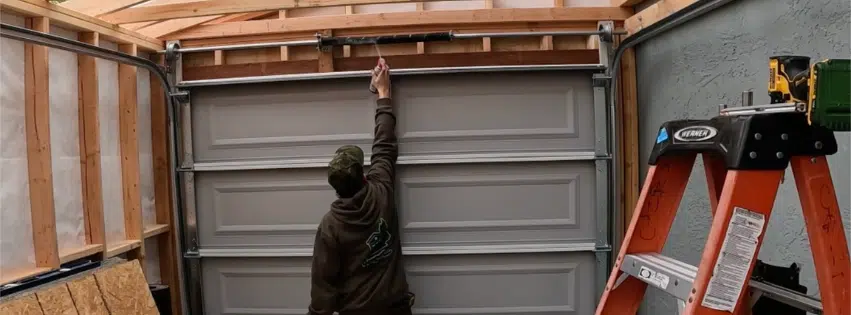
When to Call Immediately (Don't Wait for the Annual Check)
Some things shouldn't wait for a scheduled maintenance visit. Call a professional right away if you notice:
- A loud bang from your garage — this is almost always a broken torsion spring.
- The door moves unevenly, one side lower than the other.
- The door reverses on its own without hitting anything.
- Cables that look kinked, frayed, or off the drum.
- The opener struggles to lift the door, runs slowly, or strains audibly.
- The door won't stay open or comes down on its own.
The Bottom Line on Garage Door Maintenance
Your garage door doesn't need a lot. It needs consistent lubrication on the right schedule, an annual once-over by someone paying attention, and a professional full-service every three years to keep the mechanical side calibrated correctly.
If you're in Contra Costa or Solano County and it's been a while since anyone looked at your door — or if it's making noise, moving slowly, or just not feeling right — get in touch. I offer professional garage door tune-up service and I'll give you a straight assessment of what your door actually needs, nothing more.
(925) 316-8384 | gengaragedoors.com
Dustin Cantu — Owner, Generational Garage Doors. Martinez, CA. CA Contractor's License #1113495.